Street trees: a guide for municipalities and designers
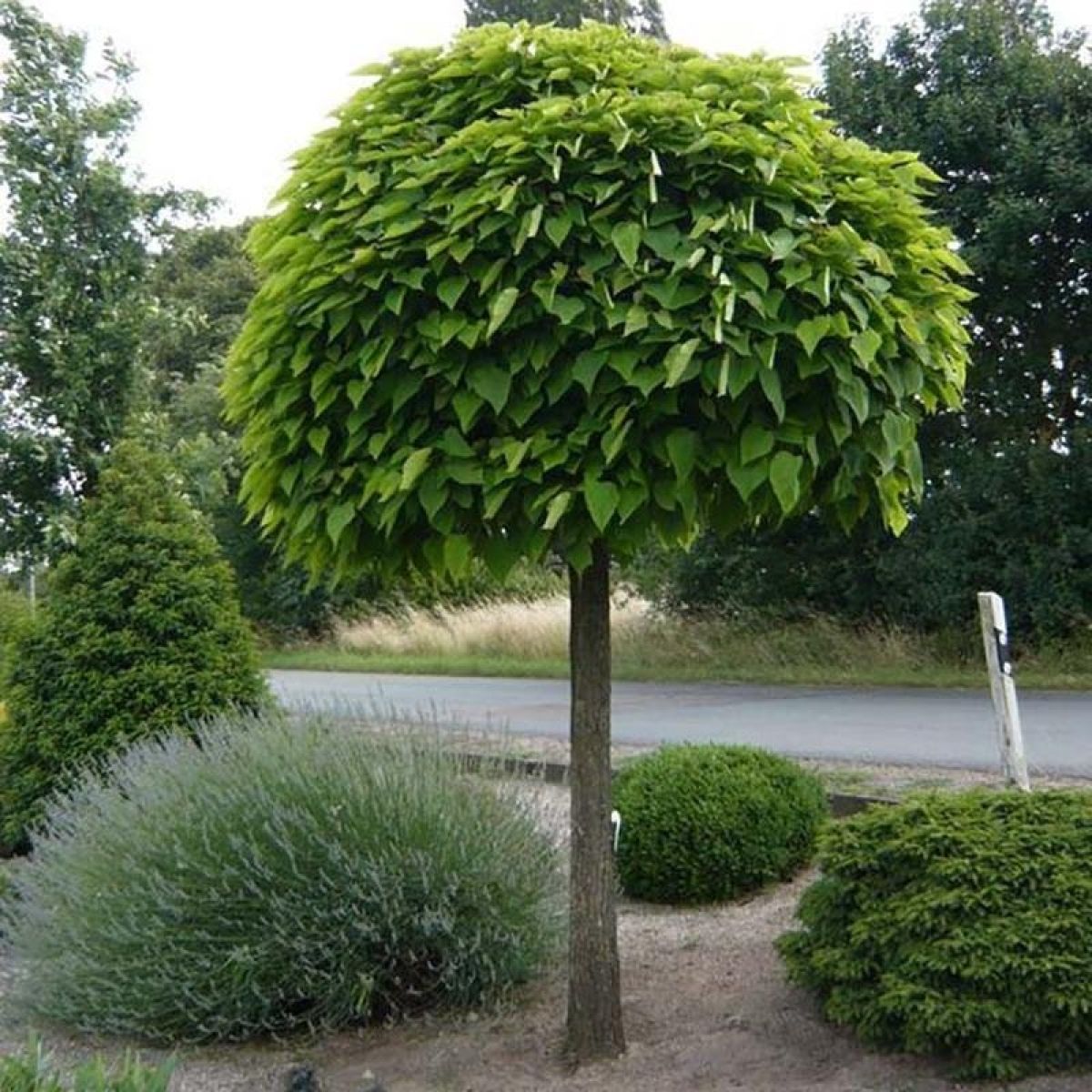
Street trees live in harsh conditions: compacted soil, limited root space, heat reflected from asphalt, pollution and de-icing salt. Choosing the right species and size is decisive for the planting to last for decades without causing problems with utilities, pavements or façades.
What to check before choosing the species
- Street width and distance to buildings – these determine the maximum crown size.
- Overhead and underground utilities – under power lines choose small species or globe-shaped forms.
- The soil volume available for roots.
- Sun exposure and reflected heat.
- Maintenance requirements – large leaves, fruit or flowers falling on the pavement.
Recommended species
Catalpa (Catalpa bignonioides) is a classic shade tree for boulevards and parks: a broad crown, large leaves, white flowers in June–July and good tolerance of urban conditions. Globe-shaped forms are used for narrow streets.
Japanese cherry (Prunus serrulata) is ideal for residential streets, squares and school yards: medium size, 6–8 m, and spectacular flowering in April.
Black pine suits parks, roadsides and shelterbelts thanks to its drought and wind tolerance. For vertical accents along avenues and at entrances in regions with mild winters, Italian cypress creates striking rows.
Indicative planting distances
| Species | Mature height | Distance in avenue |
|---|
| Catalpa | 10–15 m | 8–10 m |
| Japanese cherry | 6–8 m | 6–8 m |
| Black pine | 15–20 m+ | 6–10 m |
| Italian cypress | columnar | 1–1.5 m (continuous row) |
Tree size at planting
In public spaces, trees with a trunk girth of 12–14 cm or more and a clear stem up to 2–2.5 m are usually planted, so they do not obstruct pedestrians and traffic. Large trees are supplied root-balled and planted in autumn or spring. More on formats in Balled or container plants.
Planting and care in the first years
- Planting pits as large as possible, with good-quality soil and protection against compaction.
- Anchoring with 2–3 stakes and trunk protection.
- Regular watering in the first 2–3 years, including with irrigation bags.
- Formative pruning to raise the crown and correct crossing branches.
PlantDGD supplies wholesale ornamental trees to municipalities, contractors and designers. See the wholesale ornamental trees category or send us your bill of quantities via the contact page – we also accept partial offers.
Frequently asked questions
Which trees are suitable under power lines?
Small species or globe-shaped forms that do not reach the wires; Japanese cherry and globe-shaped catalpa are often used.
How far apart are avenue trees planted?
It depends on the mature crown size: usually 6–8 m for medium trees and 8–10 m for large trees such as catalpa.
Plants from this guide, available wholesale