How many thuja per metre? Hedge calculator and planting guide
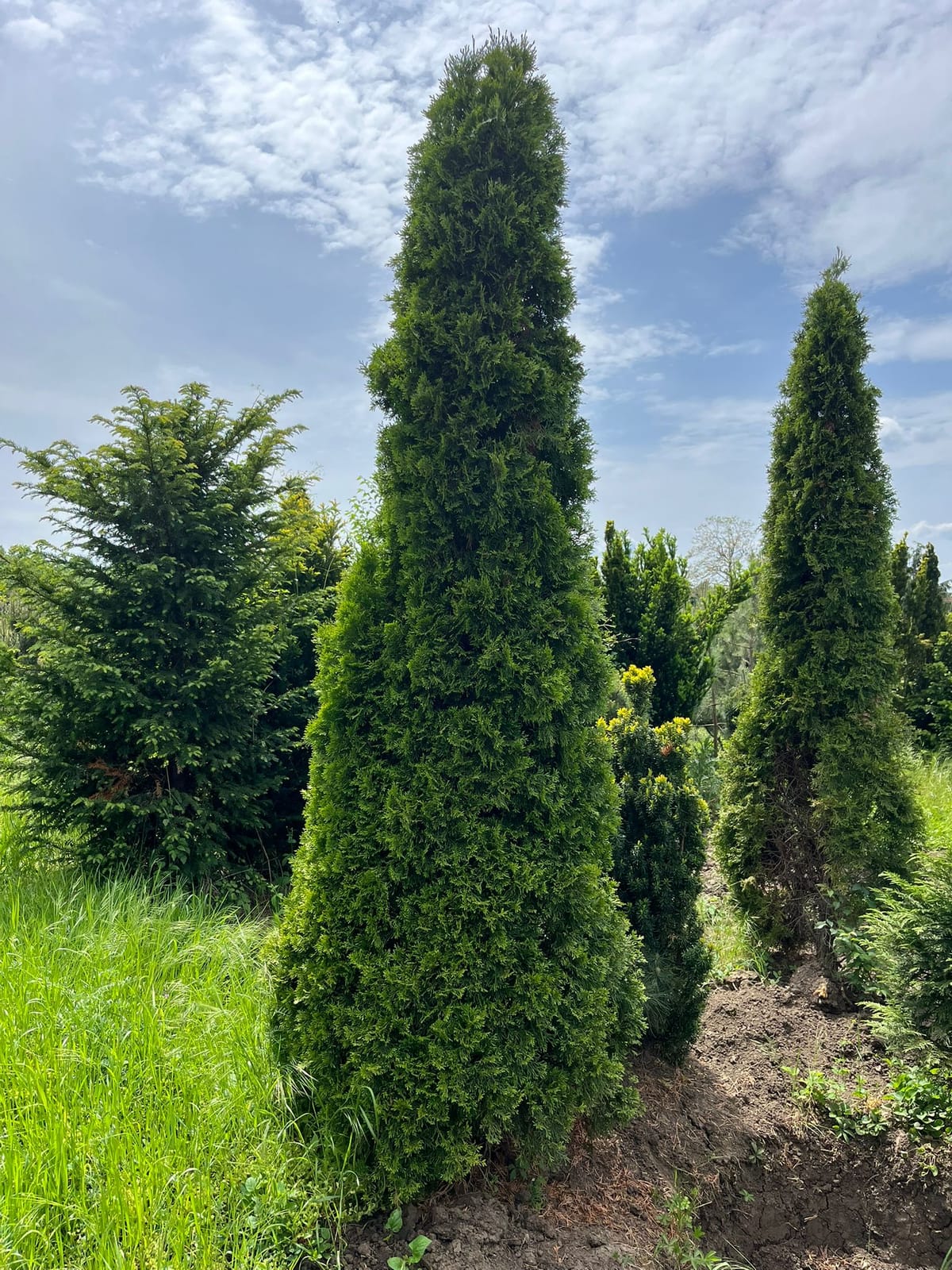
One of the first questions in any hedge project is how many plants you need. The answer depends on the species, the height of the plants at planting and how quickly you want the hedge to become dense. Below you will find the recommended spacing for the most widely used hedge plants and a calculator that quickly shows how many plants your hedge length requires.
Calculator: how many plants for your hedge
How many Thuja Smaragd per linear metre
For Thuja Smaragd the standard recommendation is 2–3 plants per linear metre, i.e. 35–50 cm between plants, measured trunk to trunk. Thuja Smaragd has a narrow columnar shape – at maturity it reaches 1–1.5 m in width – so if planted further apart it leaves gaps between plants for several years.
- Small plants (60–100 cm): 3 plants per linear metre, for a dense hedge sooner.
- Medium plants (100–150 cm): 2–3 plants per linear metre.
- Large plants (over 150 cm): usually 2 plants per linear metre, as they are already wider.
Very dense planting (4 or more plants per metre) is not recommended: the plants compete for water and light, and the lower part of the hedge can become bare over time.
Spacing for other hedge plants
| Plant | Plants per linear metre | Distance between plants |
|---|
| Thuja Smaragd | 2–3 | 35–50 cm |
| Oriental thuja | 2–3 | 35–50 cm |
| Cherry laurel | 2–3 | 35–50 cm |
| Photinia Red Robin | 2–3 | 35–50 cm |
| Leyland cypress | 1.5–2 | 50–70 cm |
| Yew (Taxus baccata) | 3–4 | 25–35 cm |
| Lonicera nitida (low border) | 3–4 | 25–35 cm |
Leyland cypress grows much faster and wider than thuja, so it is planted further apart. Slow-growing species used for low clipped hedges, such as yew and Lonicera nitida, are planted closer together.
Single or double row?
For most hedges a single row is enough. A double row, with plants staggered in a zig-zag, is used when you want a very dense screen from the start, a wider hedge or a better barrier against wind and noise. In this case the rows are 30–50 cm apart, and within each row the plants are spaced a little further apart than in a single row – usually 1.5–2 plants per linear metre in each row.
How to plant a hedge correctly
- Mark the line of the hedge with a string and dig either individual holes or a continuous trench about 40–50 cm wide.
- The hole should be at least twice as wide as the root ball or pot, and the plant is set at the same depth at which it grew.
- For plants with a root ball in netting or hessian, open the material at the top but do not break up the root ball.
- Backfill with soil mixed with compost, firm gently and water thoroughly straight after planting.
- Cover the soil with mulch (for example pine bark) to retain moisture and reduce weeds.
In the first two years the most important job is regular watering. Most problems with newly planted hedges – yellowing or browning plants – are caused by lack of water.
Wholesale orders for hedges
For projects with hundreds or thousands of plants, it is important that the plants come from batches that are uniform in height and density, so the hedge looks even from day one. PlantDGD supplies wholesale hedge plants throughout Romania and Europe. Send us the hedge length, species and desired height via the contact page and we will calculate the quantity and send you a quote.
Frequently asked questions
How many thuja do I need for 10 metres of hedge?
For Thuja Smaragd, at 2–3 plants per linear metre, you need 20–30 plants for 10 metres, depending on the height of the plants.
How far from a fence or building should thuja be planted?
At least 40–50 cm from an existing fence or wall is recommended, so the plants have room to grow and can be trimmed on both sides.
Can I plant thuja further apart to save money?
You can, but the hedge will have gaps for several years. Thuja Smaragd grows slowly in width, so spacing of more than 50 cm considerably delays the hedge closing up.
Plants from this guide, available wholesale