English Yew (Taxus baccata)
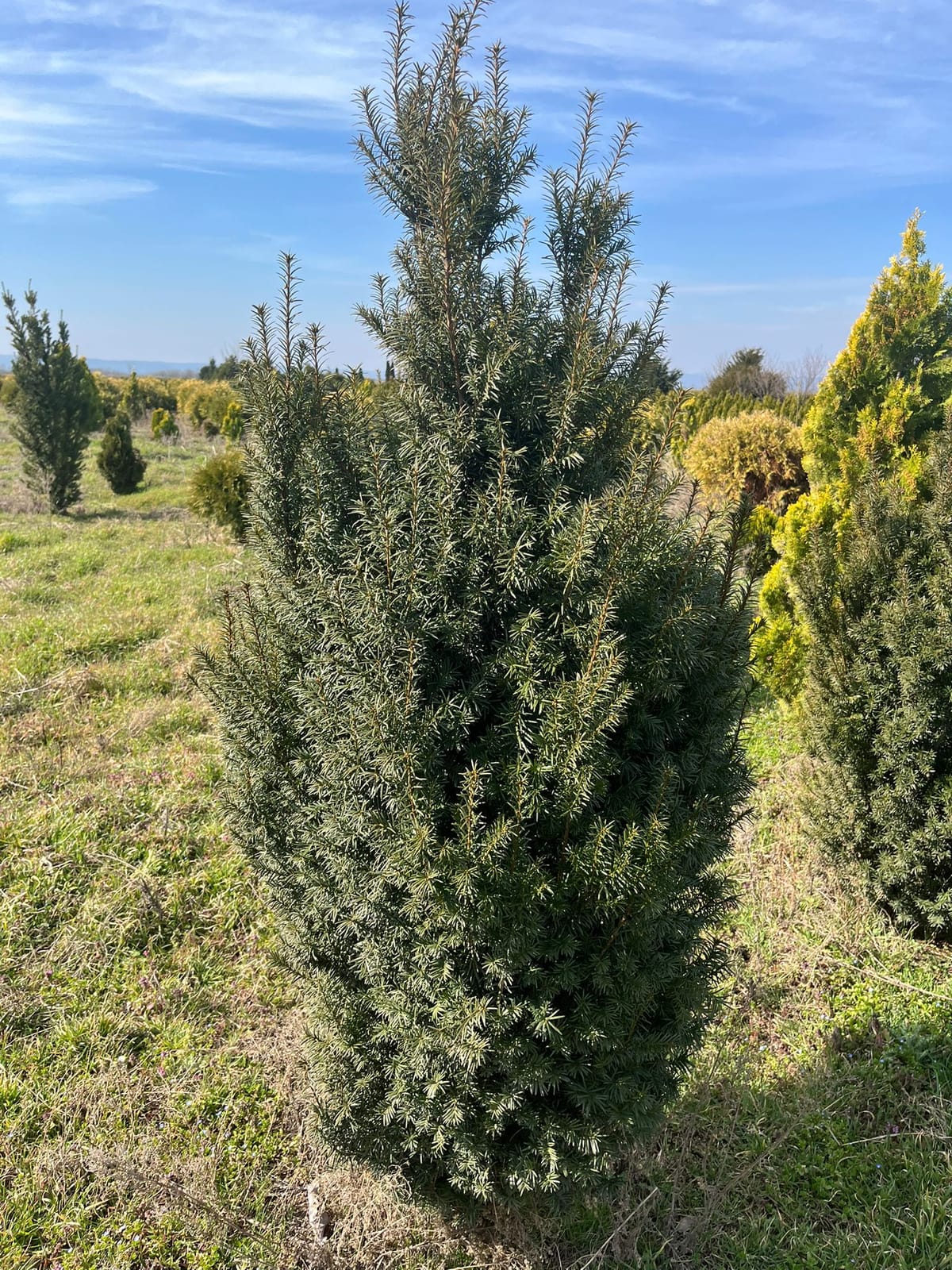
English Yew (Taxus baccata) is one of the longest-lived conifers in Europe, excellent for topiary and formal hedging. Slow growing but exceptionally durable and decorative.
Price on request – Contact us to order
Specifications
- Height: All sizes available
- Sunlight: Full shade to partial shade
- Watering: Moderate watering
- Soil: Various soil types
- Frost resistance: Hardy to -20°C
Use in landscaping projects
Yew (Taxus baccata) is the preferred conifer for geometrically clipped hedges, topiary (spheres, cubes, cones) and evergreen borders in formal gardens, historic parks and premium landscaping. It is one of the few conifers that tolerates shade well, so it is used on the north side of buildings, under large trees and in courtyards. Note: all parts of the plant (except the red flesh around the seeds) are toxic, so it is not recommended next to playgrounds or pastures.
Planting and spacing
For hedges, 3–4 plants per linear metre are planted, depending on size. Yew prefers well-drained soils and does not tolerate waterlogging. Container plants can be planted almost all year round; water well after planting and mulch.
Care and maintenance
Growth is slow (about 15–20 cm per year), but yew has a rare advantage among conifers: it regenerates from old wood, so it can be cut back hard and reshaped. Trimming is done once or twice a year, usually in early summer. It is very long-lived and needs minimal maintenance once established.
Frequently asked questions
Is yew suitable for public spaces?
Yes, in parks and formal gardens, but avoid planting it next to children's playgrounds or areas with animals, as the leaves and seeds are toxic.
Does yew grow in shade?
Yes, yew is one of the most shade-tolerant conifers and grows well in both partial and full shade.
Wholesale conifers
Useful guides